Romeo & Juliet — Week 2

Greetings from Team R&J, we had another busy week! What were we up to?


We looked closer at the play’s central themes and motifs. Romeo & Juliet is often considered as a transitional play from a time when Shakespeare started to merge comedic and tragic elements, which offers various themes: love, hatred, resistance against authority, generational conflicts and fate. With the love-theme ever so prominent, it is easy to neglect the cause for the lovers’ tragic ends. The feud between both families not only denies the play a happy ending, it is also a significant force that propels the plot.


To grasp this force and to allow the dynamics to unfold on stage, we wanted to look back at the origin of this feud, about which Shakespeare is rather silent in his play. Shakespeare’s Romeo & Juliet (1595-7) is an adaptation of Arthur Brooke’s poem, The Tragicall Historye of Romeus and Juliet, 1562. The poem elaborates much on the deadly hate among the two wealthy families and, unlike Shakespeare’s play, warns the reader of hasty love and disobedience to parents. The story of the tragic lovers was also taken up by William Painter, 1567, in his work The Palace of Pleasure. One of the original Italian sources, of which it is unknown how much Shakespeare drew on, are Matteo Bandello’s Giulietta e Romeo, 1554.


Shakespeare’s play and his sources can be traced back to historical persons and events, the feud between the Montecchi and the Capuleti families. The original dispute was caused by politics: during the 14th-century-civil wars that raged in Verona, one family chose to side with the Roman Emperor, the other one with the Pope in Rome. The extent of the roles of the two tragical lovers remains unclear. It is these political differences that are resumed in Shakespeare’s play in which two “households, both alike in dignity” break from “ancient grudge” to “new mutiny,” where “civil blood makes civil hands unclean” (Chorus).


To plant this feud-shaken atmosphere into our Verona, we embarked on an Italian journey: our production will start in Italian – and it won’t be just any start, but a dramatic one, brace yourselves! Preparatevi! To help us with proper diction, we asked Giorgio Pastore to join us.

Giorgio Pastore, Italian Diction Coach Photo: Conny Loder
Cast rehearsing in Italian Photo: Conny Loder

This was a fun activity and everyone mastered it very well. It will be a great addition to the play — come and find out yourselves in July!

What else were we up to?

We also looked closely at some key scenes of the play. Apart from the opening of the play, scene 7 (the masked ball at which Romeo and Juliet meet for the first time) and scene 14 (the deaths of Mercutio and Tybalt) much determine the plot.

Scene 7 challenges us not only to put on our dancing shoes and try out a Renaissance dance, but also introduces the love between the two lead characters. A sneak peek of our dance can be found here.

Scene 14 on the other hand becomes the play’s pivotal point. Until then, the story could have very well climaxed in a happy ending. The tragic and fatal intervention of Romeo to end the duel between Tybalt and Mercutio, together with Romeo avenging Mercutio’s death, both steer the first half of the play from comedy to tragedy. Below you can have a first look at some of these fatal moments. Our Fight Director Sara Brandt did a marvelous job in coaching our actors, don’t you think?

Stay tuned, our next blog entry will take you behind the scenes when we unravel our plans for set design and costumes.

Romeo & Juliet — Week 1

The first week of rehearsals is always super exciting because of its entire novelty: the faces, the space, the script.

The first activity for everyone thus is learning names and faces; many an ‘aha’ moment is to follow among cast & crew (“So THIS is the one who got THAT role…”) and then one turns to the sacred text. During the first read-through, we stop after each scene to clarify what happens – follow the story. And for Romeo & Juliet, it’s a heck of a story! Ever realized that this play could have well ended up as a comedy? If only the Capulets hadn’t run into the Montagues on Monday, and Romeo not gone into banishment (and utter isolation as to what really happens in Verona in the meantime) on Tuesday, and Juliet’s father not pressured for a hasty marriage with Paris (also on Tuesday), and if only Friar John had been admitted to Mantua (Wednesday), and Juliet woken up 10 seconds earlier from her so-called sleep (Wednesday)… Alack. Imagine!

If only.

Well, it’s a tragedy, what can I say, and we’ll bring you some fine deaths by sword & blade, knife and poison. But before, we need to make sure that Verona’s citizens know whom to side with: the Capulets or the Montagues? Whom will you side with?

Rehearsals Romeo & Juliet, 2019 Photo: Dora Lutz

Why I direct Shakespeare plays

Romeo & Juliet Rehearsal, 2019 Photo: Dora Lutz

Why do I direct Shakespeare plays?

My first theatre experience was – as with most of us – at elementary school. We staged a play about the history of the Monastery of Andechs, I played a damsel, and it went all wrong. I vowed to never touch theatre again, off or on stage, until I started studying literature. The first Shakespeare play I directed was Richard III at Greifswald University, the rest, as they say, is history.

Being an introvert, directing gives me the means to express what I might otherwise not be able to communicate.

Being a Shakespeare geek, directing allows me, with cast & crew, to share Shakespeare’s words and his stories.

Being passionate about theatre, directing gives me the chance to put my own vision onto stage.

Having studied at the Shakespeare Institute in Stratford-upon-Avon and having lived there for three years, exposed me not only to an intense study time of Shakespeare and his works and everlasting friendships with many wonderful fellow-Shakespeare geeks (let us not forget those wonderful nights at the Dirty Duck when, after a couple of pints, we indulged in animated discussion about some footnote or other rendition of Shakespeare’s lines), but also to a vivid exploration of his plays on stage through the RSC, as well as countless trips to theatres in London.

When I returned to Munich in 2014, I became a drama teacher at the ESM, founded the ESM Players who premiered with Midsummer Night’s Dream. We then moved to Richard III, Macbeth and Shakespeare’s Complete Works.

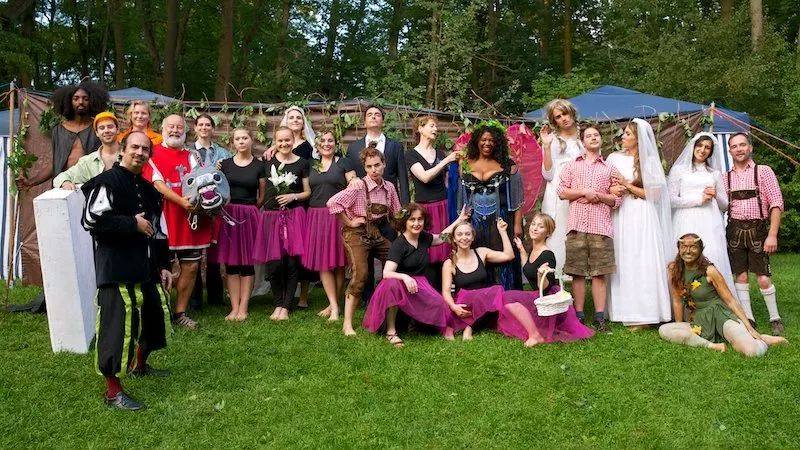
Since you can never have too much Shakespeare in your life, I also started directing with Entity Theatre in 2014, one of Munich’s finest English amateur theatre club. My first production that summer was a 60-minute-adpation of Midsummer Night’s Dream, featuring Lederhosen- and Dirndl-wearing lovers that escape the harshness of Athens.

Midsummer Night’s Dream, 2014 Photo: Tom Hafner

The following year, we embarked on Merry Wives of Windsor. We set it in Early Modern time, with colourful costumes and Sir John Falstaff prominently featuring a cod-piece, and even the set stepped up in elaboration: four doors! Not bad outdoor theatre, right?

Merry Wives of Windsor, 2015 Photo: Ken Lawler

In 2016 we presented As You Like It. The real stars were the sheep. This was also the first year in which a heavy rain shower doused cast, crew and audience, but no-one wavered. The show must go on! And on it did go.

As You Like It, 2016 Photo: Ken Lawler

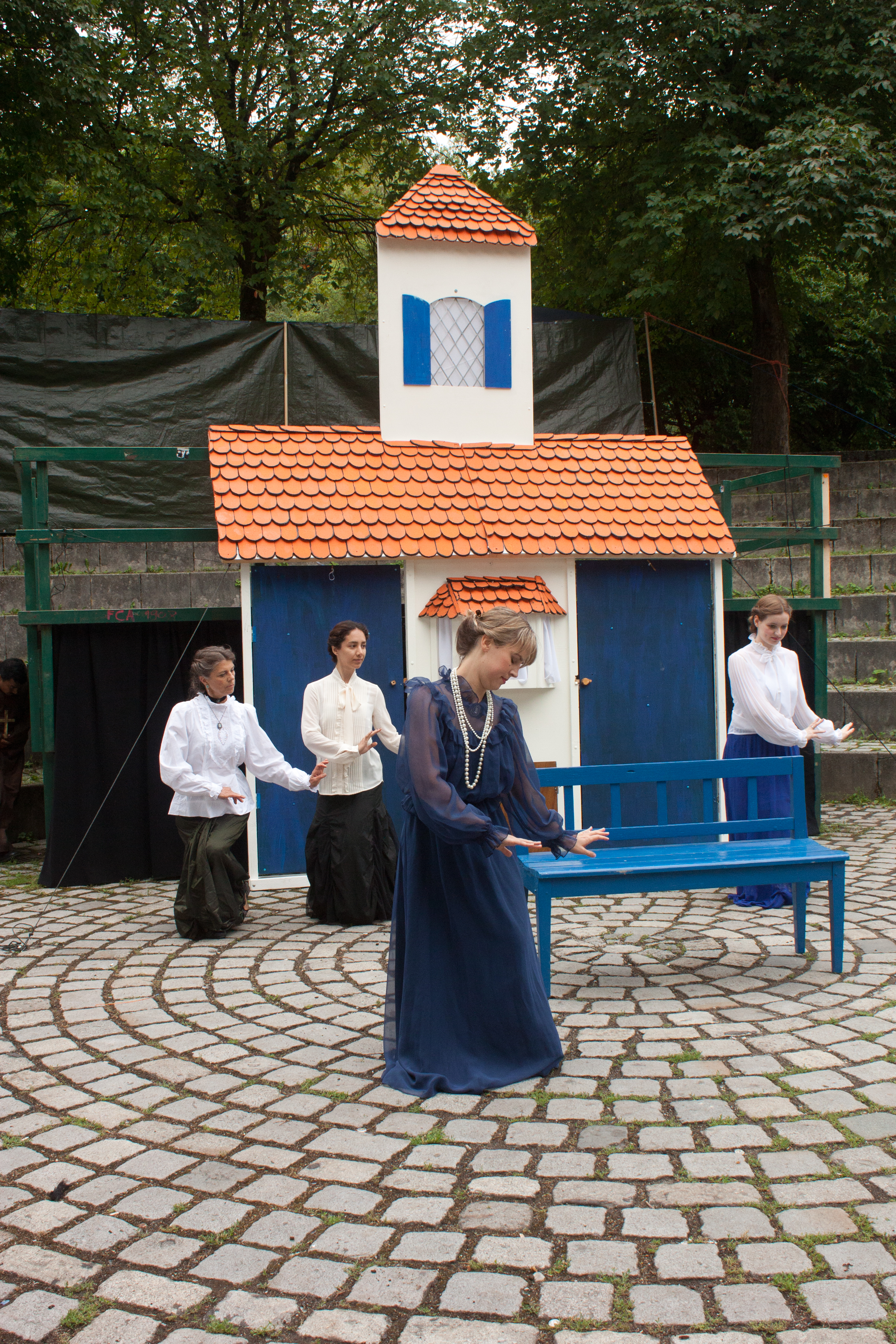
2017 marked a new start with the Shakespeare summer open air productions. We moved into a new home: the Theatron at Westpark. Our debut there was Twelfth Night. The stage naturally offered itself to a fantastic shipwreck, the permanently installed stage allowed us to present Lady Olivia’s house. Note the shingles!

Twelfth Night, 2017 Photo: Tom Hafner

2018 then became a tragic year. No worries, no-one died – at least not off stage: we took on the one and only Hamlet. And it was a great success!

This year, we resume our tragical mirth by presenting Romeo & Juliet. You can follow our journey in the months to come on this blog. Enjoy.